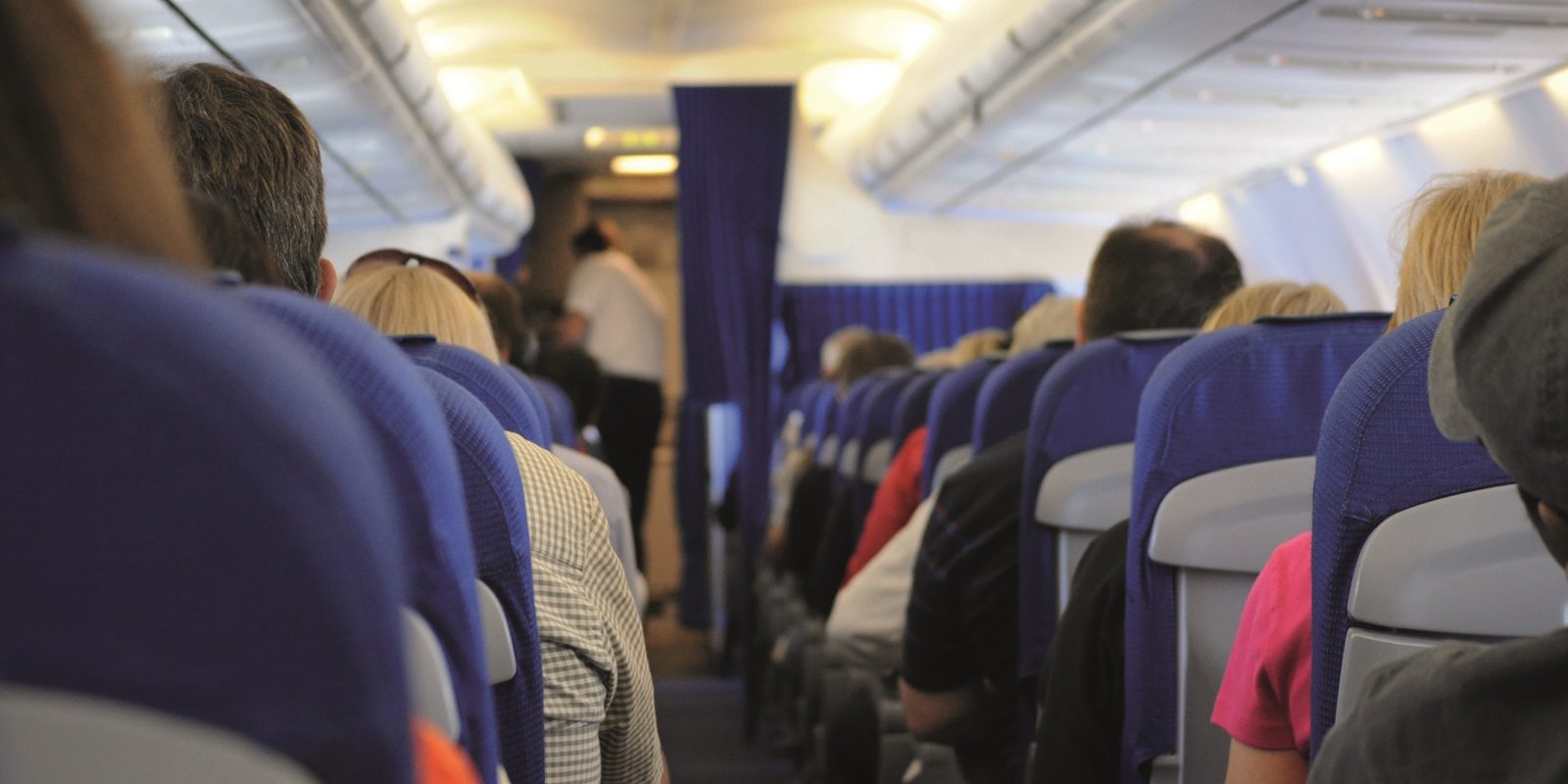
Air Travel Tips for Hearing Aid Users

By Angie Aspinall

If, like me, you use hearing aids, there are a few extra things to consider when packing for and undertaking a trip by plane. Here are my top tips to help you plan a successful trip.

1. Booking your flight and checking in

Airports are often noisy places with high ceilings and lots of hard surfaces, which make background noise seem overly loud, making it difficult for some hearing aid users to focus on one voice e.g. at the Check-in desk. PA announcements may also be difficult to hear.

If you require assistance at the airport and during the flight, it’s best to notify the airline company when you make your booking. Assistance may be available at check-in, security and for getting you to your Gate, as well as on-board. Many airlines also offer check-in online which may be a less stressful and more convenient option.

2. At the airport

If you have booked assistance at the airport, locate the Assistance Desk on arrival. There is likely to be a designated waiting area for you to use after checking-in.

Some airports have PA systems which include loop facilities, which should be clearly signed. If you have a Telecoil in your hearing aid, position yourself near the loop sign and switch the aid to the ‘T’ setting to hear announcements via the loop.

3. Can you wear your hearing aids whilst going through security?

Yes, Hearing aids shouldn’t normally set off a metal detector or x-ray machine at airport security. If the alarm sounds, security staff may give you a manual screening (which is usually a quick scan with a handheld metal detector to pinpoint the source of the alarm activation. If this happens, it’s a good idea to explain that you have hearing aids so they can eliminate that as a source, but also so they understand that communication needs to be clear.

Remember that they’ll screen hundreds of people every day; you’re highly unlikely to be the first person they’ve met who wears hearing aids!

4. Will the metal detector at the airport damage my hearing aid batteries?

“There’s nothing to worry about when it comes to hearing aid batteries passing through the various airport security scans – none of them will impact upon the performance of the batteries,” explains Paul Deeble, Rayovac’s Technical Liaison Manager.

5. Should hearing aid batteries go in hand luggage or hold luggage?

Rayovac hearing aid batteries are safe to go in both hand and in hold luggage.

“However, it is worth noting that a long haul flight may slightly affect the life of a battery that is in a device,” says Paul. “This is due to the dry nature of a cabin and any battery life loss may be more noticeable to wearers of cochlear devices or aids that take size 10 batteries.”

Paul continues: “For this reason, I would advise that you take spare batteries in their original packaging in your hand luggage if you don’t want to risk losing power on your device during a long flight. Short haul flights should make little or no difference to the life of your batteries.”

I always carry spare batteries in my hand luggage, because in the event of my suitcase being lost, I don’t want to be without enough spares to see me through the entire trip. Similarly, I pack a full set of batteries in my hold luggage in case I lose my hand luggage.

I keep all batteries in their original packaging to keep them safe. Those in my hand luggage, I have in an easily accessible place, so that I can pop them in the tray to go through the X-ray machine with my mobile phone and any other electronic devices.

6. On the plane

Hearing aids can be used during take-off and landing, but if you have Bluetooth wireless hearing aids, you will need to put them into flight safe mode. Make sure you’re familiar with how to do this – your hearing aid instruction manual will show you how.

Tell a member of the cabin crew if your hearing difficulties mean that you will need to be notified in person of any in-flight announcements or safety information.

Some people may be happy to keep their hearing aids on to keep abreast of any announcements, but if you find aeroplane travel too noisy and prefer to remove your hearing aids, tell a member of the crew that you will need a visual cue for communication. Some hearing aids have programmes which can reduce background noise. If you’d like to learn more about this, talk to your audiologist in advance of your trip.

“If you do remove your hearing aids, it’s always a good idea to switch them off to preserve battery life,” Paul advises.

Some airlines have captioning on their safety videos. If this is not available, ask for an illustrated safety card.

Remember to keep replacement batteries to hand during the flight, just in case.

7. In-flight entertainment

If in-flight entertainment is important to you, check with the airline what provision is available prior to booking. Some flights show movies which are captioned for deaf people/people with hearing loss, and some offer neck loops which are compatible with Telecoils, but it’s best to check before booking.

8. Top tips for air travel with hearing aid batteries

• All Rayovac hearing aid batteries are zinc-air and safe to pack in hold luggage.  They are not subject to the same stringent rules as lithium batteries, so carrying spares for personal use isn’t an issue.

• Always check with your airline what their rules are for allowable hand or hold luggage to confirm that hearing aid batteries are permitted.

• Pack your batteries carefully to avoid them being crushed or punctured and keep them away from metal objects such as coins, keys, and jewellery. If batteries touch each other, or other metal objects, they may short-circuit due to a large amount of energy surging in a short period of time, which can cause the batteries to stop working.

Paul Deeble warns: “Never keep batteries loose in your pocket or bag. Ideally, keep them in their original packaging or use a special, purpose-made hearing aid battery holder, such as one of Rayovac’s battery caddies.”

We have worked hard to ensure that this information is accurate and up to date, but it is best to check with the airline before traveling!


Travelling to a destination with a different climate? Read our blog on hearing aid batteries in humid, cold or high altitude environments
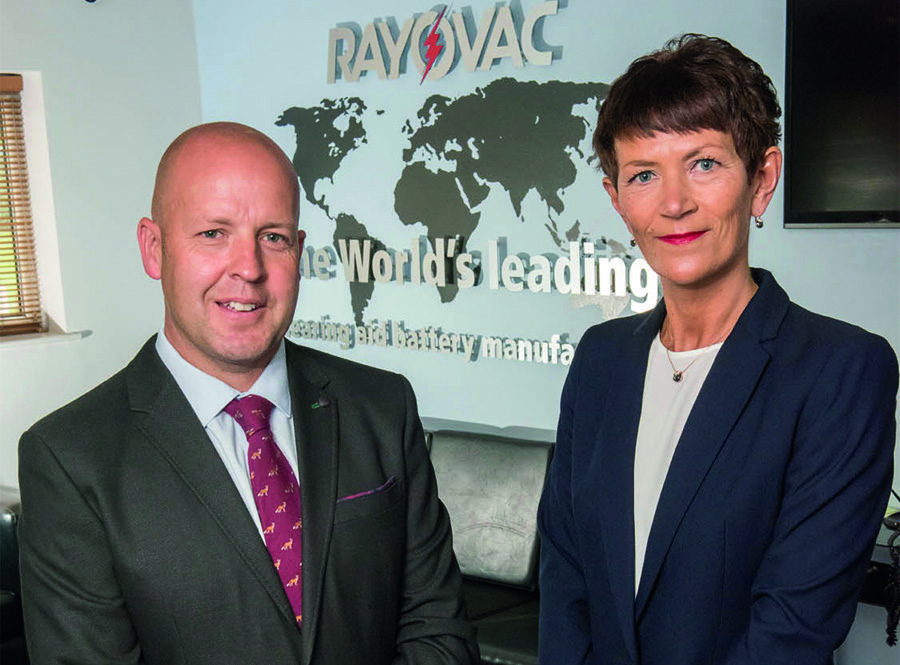

Rayovac Washington Plant Boosted By Multi-Million Pound Investment

Washington based global hearing aid battery manufacturer, Rayovac, is spearheading major growth plans thanks to a year-on-year multi-million pound investment programme.

The company, located at Wearside’s Stephenson Industrial Estate has invested heavily into its people, products and plant to meet the growing demand for hearing aid batteries around the world.

Among the investments is a new state-of-the-art packaging line to support the roll-out of its new premium packaging, as well as plans for expansion at the site to further grow its manufacturing capacity.

Rayovac has a long history of innovation, technology and skills and its continued investment into the North East is supporting the creation of new jobs in the region, with the company now employing more than 300 people out of its Washington plant.

It exports hundreds of millions of batteries out of Washington across the globe, with the aim of ensuring that a person’s hearing impairment doesn’t get in the way of their everyday life.

The company has strengthened its highly skilled workforce with additions to both manufacturing and support staff.

Among the new appointments is Washington plant manager, Julie Heads, who brings a wealth of experience to the role having held senior positions with leading North East manufacturing firms.

She said: “I’m delighted to join the Rayovac team at such an exciting time. The growth of the business has meant that investment in the technology and people at the plant has continued. It’s really important that our plant sites remain fit for purpose and we are looking forward to further exciting developments including the expansion of our Washington plant and the addition of new machinery.

The latest investments follow a successful year of growth for Rayovac, including the European launch of its new Active Core Technology, which offers consumers high-quality performance throughout the life of the battery – its longest lasting battery yet*.

Global General Manager and Vice President for Micropower, Glen Rutherford, said: “It’s a really exciting time for Rayovac and we’re thrilled to be investing in our North East base here at Washington.
“Amid the ever-changing manufacturing sector, we are continuing to grow with the market and our latest investments demonstrate a clear roadmap for the future and a vision to further develop and leverage our technology.

“Everyone who works at Rayovac is passionate about the business and our continued success is testament to our highly flexible, adaptable and skilled workforce. We will continue to research and invest in solutions that improve the lives of both our customers and consumers and we’re looking forward to an exciting and successful future ahead.”

The company is also set to unveil its next generation packaging at this year’s EUHA exhibition, the 63rd International Congress of Hearing Aid Acousticians in Hannover, Germany, this October.

For more information about Rayovac, like Rayovac on Facebook at
www.facebook.com/HearwithRayovac or follow us on Twitter at www.twitter.com/HearwithRayovac.

*Based on ANSI/IEC performance tests for sizes 10, 13 and 312 (except size 675).


Rayovac to showcase latest innovations at EUHA 2018

World leading hearing aid battery manufacturer* Rayovac, will announce its latest product upgrades at this year’s EUHA event in Hannover, Germany (17 – 19 October).

The Rayovac team are looking forward to welcoming visitors to the company’s newly designed stand at the annual industry event. Anyone who stops by stand D03 will have the opportunity to find out about Rayovac’s latest innovations, as well as the wide range of services and support customers can benefit from.

Paula Brinson-Pyke, Director of Marketing at Rayovac, said: “The whole Rayovac team is particularly excited about this year’s EUHA event. We’ve been working closely with both healthcare professionals and hearing aid wearers and we have made significant investments into our latest product offerings, which we are looking forward to sharing with delegates on the ground.

“Our focus is on developing a product range and full battery system that works as hard as possible for people and delivers on the things that matter the most to them – keeping them powered through any situation and designing a product that suits their lifestyles.

“All Rayovac ProLine customers can benefit from our product upgrades, as well as the wide ranging support tools, marketing and loyalty programmes we offer to help audiology businesses make the most of batteries as a revenue driver.”

Customers are invited to visit Rayovac and discover all the new features and benefits of its most advanced battery system yet at stand D03 at EUHA 2018, the 63rd International Congress of Hearing Aid Acousticians in Hannover, Germany (17 – 19 October).

During the event Rayovac will also host its annual Evening of Excellence where the 11th European Audiologist of the Year will be crowned.

For more information about Rayovac, like Rayovac on Facebook at www.facebook.com/HearwithRayovac or follow us on Twitter at www.twitter.com/HearwithRayovac


Hearing Loss Hour – a live social media event for people with hearing loss

#HearingLossHour

In 2015, Angie Aspinall launched a monthly, live social media event, as a ‘time to talk about hearing loss’. 

She tells us more about why she started #HearingLossHour.

When I was thirty, I started to lose my hearing, gradually, in my right ear due to otosclerosis. I needed a hearing aid, but I found it uncomfortable, and it was so loud that it made my head hurt. Rather than use the hearing aid, I joined a lipreading class.

I felt as though I was the only person my age coming to terms with hearing loss. The other students in the class were very elderly and, after two years, I still hadn’t met anyone my own age with hearing loss.

A few years later, I developed mild hearing loss in my ‘good’ ear, and I started wearing a hearing aid. On the whole, I got used to having single-sided hearing and positioning myself, so everyone was always on my ‘good’ side.

Sudden deafness

Then, in 2011, I suffered profound, permanent Sudden Sensorineural Hearing Loss in my ‘good’ ear. It was devastating.

After that, I could hear nothing at all in my left ear. And, all I could hear in my right ear were very loud high-pitched sounds (such as a child’s cry or a smoke alarm). I couldn’t hear speech, other than my own.

Finding solace in social media

I found it too hard to communicate with people face-to-face: writing and texting were easier. I had just joined Twitter and I found that it helped me to connect with people and overcome the feeling of isolation.  

CROS system – a lifeline

Seven months after my sudden deafness, I was fitted with a CROS system. (A CROS is a device which sits on the deaf ear and transmits sound to a hearing aid in the hearing ear.) It transformed my life. With the devices, I no longer had a ‘good’ and ‘bad’ side: wherever sound came from, I could hear it. It particularly helped me feel safer when crossing the road, and helped me to be able to join in group discussions.

Twitter for networking

In 2012, after launching a digital media business with my husband, a friend and I set up #Yorkshirehour, a weekly business networking event on Twitter. It was a great success, and that got me thinking: could a similar type of focused ‘Twitter hour’ help bring people with hearing loss together in the same way?

And so, in 2015, I launched #HearingLossHour, in the hope that it would help others with hearing loss to feel less isolated. I also launched a website with information about the aims of #HearingLossHour, how to take part, news about forthcoming discussions, summaries of previous discussions, and with resources for people new to hearing loss: www.hearinglosshour.com

The discussions have covered a wide range of topics, including ‘How can organisations and businesses improve communication channels and processes for people with hearing loss?’ and ‘Self-advocacy – How to speak up for yourself and express your communication needs’.

The impact of #HearingLossHour

US blogger, @TheDeafMama, writes about her experience of #HearingLossHour on her blog. And, award-winning Deaf Blogger, @DeafGirly even gave us a mention in her ‘Top 10 Things I love about my deafness’.

Here’s what participants have to say about #HearingLossHour:

“I love it because it totally supports my ‘no one size fits all’ approach to deafness. We all are so different with different experiences and it’s a chance to share and learn.” @deafgirly

“#HearingLossHour is a way of chatting about topics with others that share something in common (hearing loss) and to know we’re not alone. I always suggest HLH to people who message me asking for advice and where to get support from.” @Deafieblogger

“For me, it’s really nice to be part of a community sharing experiences, informed content, banter and shared knowledge. Also, it’s nice to be introduced to businesses that are deaf aware too. Tbh, I wish it was every week!” @deaftraveller

“#HearingLossHour has given me the opportunity to share ideas – in real time – on many hearing loss related topics with people who have an interest in the topics. A very valuable forum.” @kathleenlhill

“@HearingLosshour has been instrumental in helping me process my own hearing loss, it’s a support network, an educational space, and a valuable resource for both the hearing impaired and those without hearing loss.” @saralhawthorn

And, as a result of discussion during #HearingLossHour, Sara has launched @DisAbilityPR, a network for disabled PR professionals. I am so proud that something I created has had such a positive effect on people within the hearing loss community.

How to take part in #Hearinglosshour

#HearingLossHour takes place on Twitter at 1pm on the first Wednesday of the month. 

We have a different topic each time, and four questions are asked, evenly spaced throughout the hour. The questions are designed to encourage the sharing of feelings, experiences, tips and recommendations. Here’s how to take part.

We’re always eager to welcome new people in and always on the lookout for new topics, so if there’s something you’d like to discuss, please send ideas to @hearinglosshour.

#HearingLossHour is sponsored by Rayovac.

To learn more about #HearingLossHour, please visit: www.hearinglosshour.com or follow @hearinglosshour on Twitter.


Top Tips for Success at University

Starting at university can seem like a daunting prospect to some. 

Hearing loss can seem like another obstacle in the way. We spoke to Jacki Andre, an advocate for disability rights with a wealth of university experience.

I had no idea about my life path when I was in high school. (Who am I kidding? I still have no idea about my life path!) I was a good student. I earned high marks and I even won a scholarship. It seemed like a given that I would go to university. But I’m hard of hearing and I floundered to figure things out. Could I handle university, given my hearing? And if I could manage the studies and succeed, how would I fare afterwards, in the career that I had studied for?

But I felt like my options would be super limited without any post-secondary education, and so I enrolled in a liberal arts program at my local university. I ended up earning both a B.A. and a M.A there. (Yes, I succeeded!) 

After I finished my studies, I tried a few different jobs before settling into my current career: program coordinator at my alma mater’s accessibility office. Yep, I arrange accommodations for students who face the same questions and issues that I did.

Let me tell you: I know university can be scary. I worried about all kinds of things, like:

  • The classes are so big! If I tell the instructors about my needs, will they remember who I am in that sea of faces?
  • Will I be able get a seat where I can hear okay and/or lipread?
  • Will I be expected to listen to podcasts or watch uncaptioned videos?
  • Will the instructor be willing to wear a FM mic?
  • Will I have to do group work and explain to the other students that I’m hard of hearing?

But let me tell you this too: if I could do it, so can you!

Each person experiences hearing loss differently. Not only does the level of our hearing vary, but the supports that work best for each person and/or the supports that each person prefers to use differ too. There are lots of different accommodations available for university or college students who are hard of hearing. Some will work better for you than others. Don’t be shy about trying them all to find the ones that are best for you.

Register with your Student Support Offices

In primary and high school, we typically don’t have to explain our needs to each teacher or advocate for ourselves. Instead, in conversation with our parents, the school creates an Individualized Education Plan (IEP) for teachers and administrators to follow.

It’s different in university. The school doesn’t notify your instructors about your needs. Students must be proactive and take charge of their own accommodations. There is a benefit to this: you can pick and choose which supports to use.

The first step is to contact the office at your school that provides accommodations. It might be called something like “Disability Services for Students” or the “Centre for Accessible Education” or “Access and Equity Services.” Each institution and accessibility office has different policies, but usually you need to present some sort of documentation in order to register with the office. Once you’re registered, the staff there will let you know what kind of supports are available for you. They will also explain what you need to do in order to utilize those supports.

Talk to your Instructors

In university, you will have a LOT of different instructors and you will need to advocate for yourself with each one. What does that mean?

Because universities don’t create IEPs, instructors aren’t notified by the school about a student’s accommodation needs. Students usually need to tell each instructor themselves. Most schools have a process in place to make that easier. 

At my school, students request letters for their instructors with a few simple clicks in their online student accounts. The letters don’t state a diagnosis, but they do list the accommodations that the student needs. Students give those letters to their instructors and we encourage them to have a conversation with their instructors as well. Don’t be shy!

Instructors understand that, by law, accommodations must be provided. They know that assisting you is part of their jobs. As well, many instructors will go above and beyond what’s required. When I explained to one professor that I supplemented my hearing with lipreading, he offered to shave off his mustache so that I could see his lips better!

Ask about Peer Notetaking Programs

In university, classes are usually designated as “lectures.” A class might also have a lab and/or tutorial section, where students do practical work (labs) or discuss the material (tutorials). However, for the most part, during the actual classes, instructors just lecture. As they talk, students take notes.

Taking notes can be tough when you’re hard of hearing! You may have a hard time understanding when there’s background noise or you may have trouble lipreading and writing at the same time.

However, it’s pretty standard for postsecondary schools to offer notetaking services.

Your accessibility services office will find a student in the same class who is willing to share their notes. This is usually a confidential service. The student who provides notes won’t know who the notes are for, or why they’re needed. At my school, notes are uploaded to a cloud-type service, so that students can access them from anywhere at any time.

There’s all kinds of technology that’s useful for people with hearing loss and new devices and apps are developed all the time. Here are some types of technological support that your school may be able to provide right now (and likely new, exciting ones are on the way):

LiveScribe SmartPen

The LiveScribe SmartPen records audio that is synced with handwritten notes. When the pen is touched to a word written on special paper, the audio linked to that word begins to play. SmartPens are a good option for people who benefit from amplified audio. My school has SmartPens for loan and can also help students access government grants to buy their own.

FM Systems

Some (but usually not all) university classrooms have FM systems built-in and available for all students to use. If you would benefit from classroom amplification, your accessibility services office will make sure your classes are booked into the right rooms.

If you have your own personal FM system, of course that can be used in any classroom. Some instructors may be new to using FM systems and may need some help figuring things out. Your accessibility services office will likely have an instruction sheet that can be printed and shared as needed.

CART, TypeWell, and Other Real-Time Captioning Services

If you require real-time captioning, your school will set that up for you. Services like CART and TypeWell are often provided remotely. Lectures are streamed online, and a transcriber listens in, typing the proceedings verbatim in real time. That transcript is sent to your device (laptop, tablet, smartphone) as it’s created so that you can follow along in the classroom.

Apps

I myself use voice-to-text recognition software in some situations. In my experience, it’s not terribly accurate yet; hopefully it will continue to improve. That said, it can help me if I lose the thread of a conversation or if I need to fill in some blanks. I use an app called “Ava” for small group discussions and Ava might also work well in tutorials or group-work situations.

Investigate other Accommodations

There are a few other accommodations that your accessibility services office may be available to provide, depending on your needs.

Exam Accommodations can benefit hard of hearing students in certain situations. For instance, if your exam has an oral component (which is often the case for second language classes, like French or Spanish), your accessibility services office can help make that work for you.

As well, sometimes final exams are written in large communal spaces, like gyms, where several different classes write exams at the same time. It can be tough for hard of hearing students to hear verbal instructions in those kinds of situations or to manage their hearing aids in those cavernous spaces. If you need help with exams scheduled in this way, talk to your accessibility services office.

Residence Accommodations may be needed if you plan to live in your school’s dormitory. Flashing fire alarms are standard in communal spaces. But, typically, only a few dorm rooms are designated as “accessible” and outfitted with the safety devices that hard of hearing students need. If you will be living in residence, notify your school’s accessibility services office and its residence office when you apply for a room so that you are assigned a safe, comfortable space.

Yes, going to university can be daunting when you’re hard of hearing! But if you’re in touch with your accessibility services office, if you’re proactive, and if you’re willing to try different accommodations to see which ones work best for you, you’ll set yourself up for success. And success at university can send you hurtling up your own life path, with a clear destination in view.

Why not read our article ‘Back to Uni‘ for some extra tips for students?


Ready? Steady! Go! Strategies for successful job hunting as a hearing aid user

It would be naïve to say members of the hearing impaired community find it easy to get work, when in fact they are four times more likely to be unemployed than job seekers in the general population. Many others are stuck in entry level jobs, unable, for various reasons, to find work which makes use of their qualifications, skills and abilities.

Action on Hearing Loss estimate that nearly 4 million Brits of working age (and around 360 million people in total around the world) have some level of hearing loss. That’s an awful lot of people who are missing out on the positive mental health benefits such as increased happiness, feeling more settled and a stronger sense of self worth, a job supplies.

So we know that hearing problems can make both finding and keeping a job more of a challenge, but why is this the case? In some cultures partial or full deafness is explained by superstitions, or even curses, but in most both emotional and practical factors are thought to play a part. Jobseekers have to deal with feeling self conscious about having hearing aids, a visible sign of being ‘different’, while potential communication difficulties along with weak support systems in the workplace trigger concerns amongst employers.

The good news is this situation can be improved. With some planning, flexibility and a positive attitude there is no reason why wearing hearing aids should mean missing out on the world of paid work, or, more specifically, breaking into the career you really want to make your own. 

A World Wired for Sound

Denmark is a progressive country, and the Danes are known for being one of the happiest set of people across the globe, despite high income taxes! In return they enjoy decent public services and solid support from the government. There the hearing impaired are twice as likely to be unemployed, but that’s still half the UK figure. Understanding why this is the case provides useful clues which can be adopted by job seekers anywhere in the world.

In a nutshell full and partially deaf Danish people benefit from the positive attitudes common amongst both the general public and employers, who tend to be more understanding of, and willing to provide support for, those who need something extra from the workplace and co-workers.  In a work environment this approach means communication between those with hearing challenges, and their colleagues, clients, customers and managers, is much easier.

Get Ready! Identify what you want; what you love doing, and what you are good at.

Approach your job search from the same point as anyone else, by considering what you want to do, what you can do, what you would love or hate doing all day, what you find easy, and what is difficult? Of course there are going to be limitations, but everyone has those. Ballet dancers who grow too tall have to adjust their expectations, so although wearing a hearing aid rules you out of certain jobs there are plenty of things that you could tackle. Once you know where your passion is you can identify any further training, learning or experience you need to get under your belt to move things on. 

One popular blogger who weaves direct personal experience into his writing on topics about living with hearing loss, is a fierce advocate of not settling for less than you really deserve, even if it takes some compromise. “The big mistake I see people make … is to look at a job they’d like to do, a job they could love, and think they can’t do it because they can’t do it exactly like someone else is doing it.” Sure, you may need to do some adapting, or consider different approaches to a task, (more on that later), but you don’t have to settle for just anything when it comes to job seeking. 

Get Steady! Address the elephants in the room

When exactly is it best to introduce the fact that you use hearing aids? One strategy is to simply say nothing until you reach the interview stage. There’s nothing wrong with that, unless the application process asks about your hearing abilities directly. Still, a personal appearance for an interview sporting hearing aids will give the game away, so it makes sense to have ideas for your next move or two up your sleeve.

Have you ever thought that wearing hearing aids can actually be an advantage? Writer and film maker Charlie Swinbourne believes that struggling to communicate without them is a classic self sabotage technique, and one which risks making the hearing impaired come across as slow and less capable. Rather than feel ashamed by his differences he embraces the signals hearing aids provide to others, and the way they make it easier for him to ask for help with communication when needed. The bonus here is that modern aids can be much more attractive than the standard designs of the past, so go for bold colours or fancy designs if that makes it easier to show the world they are simply one part of your life.

Don’t panic if that doesn’t appeal; there are other ways to approach the unspoken concerns many interviewers tend to have, and these are equally important whether or not you have chosen to make your hearing aids a fashion statement.

Check out any quota filling potential

Many countries around the world have created legislation to help those with different needs find work. Sometimes known as ‘positive discrimination’, companies must meet government set quotas on the percentage of people with a disability they employ. Failing to do so can result in heavy fines, so providing an employer falls under the scheme – which usually only applies to firms with a varying minimum number of staff on the books – the chances of finding a job with them could be easier. Unfortunately this isn’t a universal practice, and other countries, including the UK since the quota scheme was abandoned two decades ago, rely instead on anti-discrimination laws. These tend to have fewer teeth and are much harder to enforce, but there’s still one more card to turn on this table and it could well be the one that wins you the jackpot!

Go! Openly address the common fears and misconceptions employers have

British job seekers who rely on hearing aids have a better chance of success if they take a proactive role in the interview process. Employers are legally obliged to make ‘reasonable provision’ for those with hearing difficulties, so long as they are aware of the issue, and it’s likely that few would object to doing so – except they often don’t have a clue what that actually means.

The reality is that during an interview employers are probably wondering and worrying about the exact same things you have at some point. Can you manage the work expected? Will you be able to get along with colleagues? Is communication going to be difficult, or even impossible? By troubleshooting these issues, and presenting reasonable solutions to problems the panel haven’t voiced you are much more likely to succeed.

Communication Conundrums

This is by far the biggest concern, as two thirds of hearing impaired workers without special provisions struggle to communicate efficiently with co-workers, clients and/or managers. No wonder employers anticipate problems at meetings or during telephone calls, never mind quaking at the thought of how much it would cost to make necessary changes to accommodate someone with special equipment.

Imagine the difference then if you can supply details of schemes like the grants from Access to Work. Job hunters can apply for these at any time, rather than having to actually start work to be eligible; allowing employers to buy essential equipment such as a text phone or hearing loop to make communicating much easier.

A Few Easy Tricks

Deaf office workers relaying their tips for creating a positive and productive workplace experience mention the need to be upfront about, and not ashamed of, your hearing issues – as most people actually welcome the chance to learn how to communicate well with you. Other suggestions included asking for help as you need it, and working from a space which looks out onto as much of the office as possible. Gian Luca also recommends paraphrasing key points in meeting to check for accuracy, opting for video chats over telephone calls if that helps, and sending a summary of notes taken during a meeting to all participants – so any misunderstandings can be clarified.


Wrapping it up

Perhaps the most important message you could take from this article is that being openly identified as hearing impaired because of your hearing aids is a fact of life, rather than something which has to shape your expectations or achievements. Finding a job that you want is entirely possible, and although your path to employment may not be conventional it’s no less worthy than anyone else’s.


Hard of Hearing Survival Guide for the Festive Season

The festive season can be one of the most stressful times of year for hard of hearing people with all of the commotion, group conversations and loud music. We’ve put together a handy set of tips for the hard of hearing to enjoy the fun with the minimum amount of stress!

Family time

It’s a fantastic feeling having all of your family together under one roof, however, there can be a lot of background noise.

One at a time!

Keeping up with conversation and lip-reading with more than one person can be a challenge. Remind your family to speak one at a time.

Additional Ears

Background noise from music or other conversations may make it difficult to carry out a conversation.  Ask a friend or a family member to be your hearing buddy if you are at a family gathering. They can help you keep up-to-date with what’s being said and will offer support if you miss-hear something.  Don’t be afraid to ask someone to repeat what they said.

Quiet Zone

Don’t strain over background noise if you want to have a conversation with your friend or family member. Either find a quiet place away from the TV or family games to talk, or ask if the music can be turned down slightly.

Eating out

Eating out means less housework, but it does mean busy venues and background music which can mean you are straining to hear the conversations.

Inform the Venue

Contact the restaurant you have booked for your festive feast and request your table is reserved in a quiet area, away from loud speakers, heavy traffic and the kitchen area.

Prime Seat

Choose your seat wisely! Select a seat so your back is against the wall. This means no one will be passing or talking behind you, which could be distracting.

Face to Face

Ask your fellow diners to face you when they are talking.  Ask them to avoid covering their mouths or talking whilst eating. Those who are sat next to you, ask them to tap your arm if they would like to speak to you.  Remind your family or friends of your hearing loss so they know you are not being rude if you don’t respond straight away.

…and Relax

This time of year is about creating memories with your friends and family regardless of your hearing difficulties. If you need to give your ears a break, don’t be afraid to take time out by either sitting in a separate room or having five minutes taking in the fresh air.

From all of us at Rayovac, whatever you get up to, happy holidays!

If you have any great Hard of Hearing tips you would like to share, tweet us at @HearwithRayovac or find us on Facebook.


Hard of Hearing Survival Guide for the Festive Season

The festive season can be one of the most stressful times of year for hard of hearing people with all of the commotion, group conversations and loud music. We’ve put together a handy set of tips for the hard of hearing to enjoy the fun with the minimum amount of stress!

Family time

It’s a fantastic feeling having all of your family together under one roof, however, there can be a lot of background noise.

One at a time!

Keeping up with conversation and lip-reading with more than one person can be a challenge. Remind your family to speak one at a time.

Additional Ears

Background noise from music or other conversations may make it difficult to carry out a conversation.  Ask a friend or a family member to be your hearing buddy if you are at a family gathering. They can help you keep up-to-date with what’s being said and will offer support if you miss-hear something.  Don’t be afraid to ask someone to repeat what they said.

Quiet Zone

Don’t strain over background noise if you want to have a conversation with your friend or family member. Either find a quiet place away from the TV or family games to talk, or ask if the music can be turned down slightly.

Eating out

Eating out means less housework, but it does mean busy venues and background music which can mean you are straining to hear the conversations.

Inform the Venue

Contact the restaurant you have booked for your festive feast and request your table is reserved in a quiet area, away from loud speakers, heavy traffic and the kitchen area.

Prime Seat

Choose your seat wisely! Select a seat so your back is against the wall. This means no one will be passing or talking behind you, which could be distracting.

Face to Face

Ask your fellow diners to face you when they are talking.  Ask them to avoid covering their mouths or talking whilst eating. Those who are sat next to you, ask them to tap your arm if they would like to speak to you.  Remind your family or friends of your hearing loss so they know you are not being rude if you don’t respond straight away.

…and Relax

This time of year is about creating memories with your friends and family regardless of your hearing difficulties. If you need to give your ears a break, don’t be afraid to take time out by either sitting in a separate room or having five minutes taking in the fresh air.

From all of us at Rayovac, whatever you get up to, happy holidays!

If you have any great Hard of Hearing tips you would like to share, tweet us at @HearwithRayovac or find us on Facebook.


Top Tips to keep your dog calm during fireworks

A lot of dogs can often become spooked by the loud cracks and bangs of fireworks which often reach up to 120 decibels. This is as loud as a nearby chainsaw! It’s no wonder that dogs can become scared. A dog can hear higher frequencies, meaning they can often hear noises humans can’t!

As a hearing aid user you have the option to remove your hearing aids to reduce the loud noises of the fireworks, but still enjoy the impressive light displays. Your dog doesn’t have this option available and will be alert to all of the sounds. A nervous dog will display traits which are different from their usual day to day personality; here is what to look out for.


How to tell if your dog is nervous during fireworks:

  • They may bark a lot more than usual
  • They may start to tremble and shake or hide in corners, try to reassure them
  • They may pant excessively and salivate a lot more than usual. Make sure they have access to clean drinking water.
  • Pacing and not knowing where to lie down is a common sign of anxiety/nervousness.
  • It is not uncommon for a nervous dog to have an accident or display destructive behaviour, keep breakable items out of the way.
  • Yawning is a common trait of a nervous dog
  • Scratching and nipping themselves. They aren’t itchy but they may develop a rash or skin irritation through this nervous habit.
  • They may refuse to eat. Keep some food down for them and offer them treats.

We spoke to Hearing Dogs for Deaf People and they gave us some great tips to share on how to keep your dog safe and calm during fireworks.

Find out what’s going on

Check with your local council for where and when the local firework displays are being held. Ask your neighbours if they are planning on having a private garden display.

Keep your dog busy

Distraction is great technique to occupy your dog from the outdoor noise. Try playing retrieving games or trick training. Have some tasty treats and fun toys on standby. Keep rewarding your dog with verbal praise..

Wrap them up!

Wrapping your dog in a blanket, in much the same way as a crying baby, is often found to reduce anxiety due to a light constant pressure. There are also specialist thunder jackets you can purchase either online or from a local pet store.

Wrap your dog up before, during, and after the firework display and help reduce symptoms of anxiety such as shaking, panting, drooling, and hiding.

If your dog chooses to remove the blankets, don’t force him to have them on. It may feel strange to your dog at first and they may feel too warm after a while. Don’t leave them on their own.

Make a Safe Zone

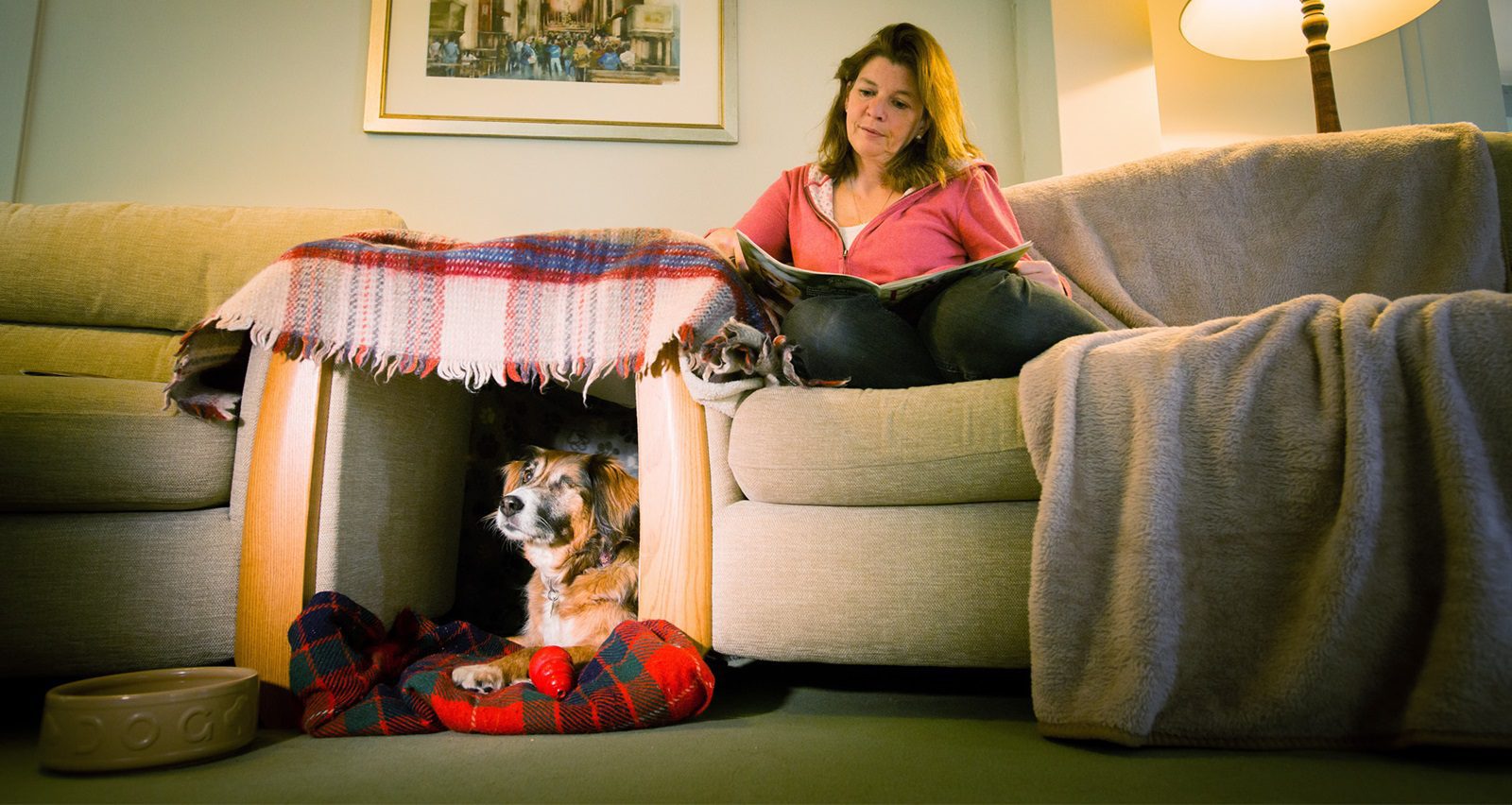
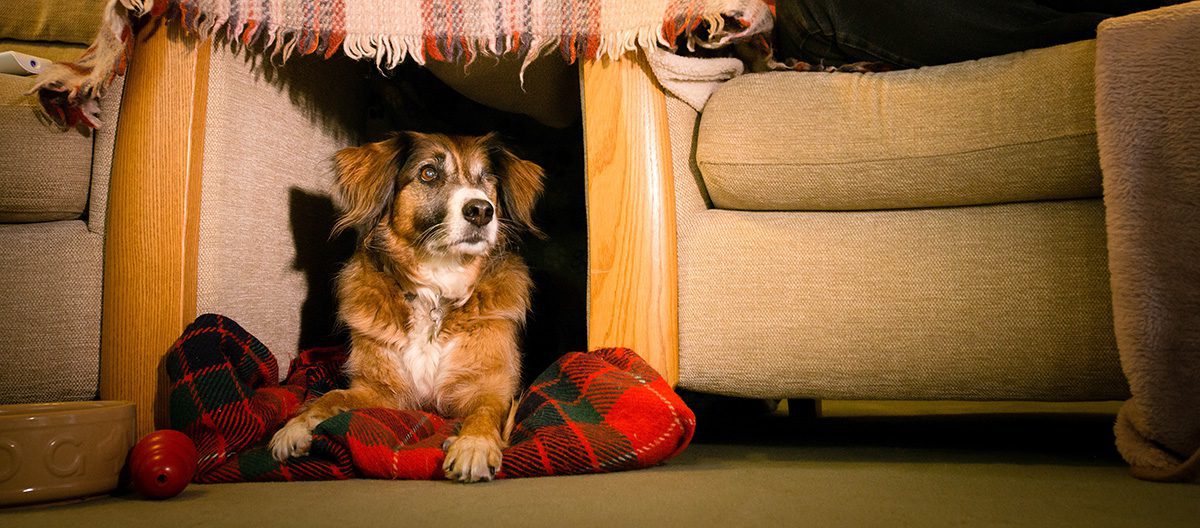
An anxious dog likes to have a place it feels safe, it’s important to create them a cosy den.

Make a covered den in the centre of the house, away from windows and walls, with easy access in and out. Place a comfy bed inside, with extra blankets for him to burrow in, plus a selection of tasty treats and some favourite toys
Put the radio on and tune into a classical channel – dogs find this relaxing!

Try not to fuss but be aware

It’s ok to support your dog if he is scared. Allow him to try and settle where he feels comfortable. Over fussing or yelling at your dog will heighten his senses and he may think there is a problem. Act as relaxed as you can.

Early Walks

Fireworks will begin when it is dark so take your dog out for his nighty walk before dusk. This will relax him and relieve his toilet requirements. If you think he needs to be taken out again, wait until the fireworks have finished and keep him on a lead.

Forgive your Friend

A scared dog can be a destructive dog; he won’t mean to accidently knock over a vase or go to the toilet on your new rug. Getting angry will only make the situation worse, so keep calm.

Secure your home

Your dog may look for an escape route from your home. Lock your doors and windows as you usually would, but have one last check to ensure your dog does not have an escape route. Block off any unsafe areas which you may think he could get into.

Draw the Curtains

It’s not just the noise; flashing lights may also startle your dog. Keep your curtains closed and turn the lights on in some rooms and keep it dark in others. He will decide where he feels most comfortable.

Finally, be there for your dog! He is there for you when you need him most. Keep him company through the evening and we strongly advise your furry friend should not attend a firework display.


If you do find your dog’s fears worsen, contact your local vet for further advice. If you have a Hearing Dog contact your Hearing Dog representative.
For more information about Hearing Dogs please visit www.hearingdogs.org.uk